APT satellites give about
12 good images a day, wherever you are in the world. The resolution
is 4km per pixel and there are visible and infrared sensors.
This is a simple system where the satellite is in low earth
orbit and very easily received at 137MHz. The two frequencies
in main use are 136.50 for NOAA 12 and 15 and 137.62MHz for
NOAA 14. A simple crossed dipole antenna can be used, or for
marine use a stainless steel Quadrifilar helix antenna. These
simple omni-directional antennas do not need moving or tracking
to receive the satellite. The satellite is so strong that when
is about 20 degrees above the horizon perfect results will
be obtained.
As this is the lowest cost entry into weather satellites,
a lot of people have asked if they could use their "scanner" that
they use for monitoring other transmissions. There are two
problems with using receivers not specifically designed for
weather satellites. The first and most important is bandwidth,
a APT signal needs about 40kHz of bandwidth, between 30 and
50 is OK. Most scanners have 15KHz which is far too narrow
and 180kHz or more which is far too wide. Only a few scanners
have the correct bandwidth and these currently include the
AOR5000 and Icom IC-PCR1000. The second problem with all scanners,
including the ones mentioned, is that a weather satellite system
needs a very good performance receiver, one that provides high
sensitivity, good signal to noise and high immunity to other
adjacent transmissions. So, you may get your scanner to work,
but it will not provide the results you see in our colour brochures.
Our PROscan receiver has been specially designed to provide
optimum performance.
APT Polar Antennas
The crossed dipole antenna is recommended for nearly
all applications. It is made from aluminium and is strong
and durable. It can be fixed onto a vertical mast and should
be positioned as high as possible.
The satellite signal
will not go through trees or buildings and to get the
best possible continuous signal it needs to be mounted
onto a mast as high as possible. On the end or top of
a building is preferred although, for test purposes,
it can simply be stuck into the grass at ground level.
Ground level antennas will only give you a few hundred
miles either side of your location, but it is a start.
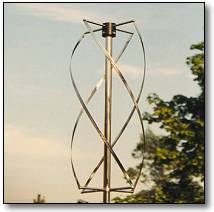
The Quadrifilar helix antenna is designed especially
for marine use. It is made entirely from 316 stainless
steel and derelin plastic and is extremely strong.
It offers slightly better performance than the crossed
dipole but is in the price range of Super Yachts
rather than the guy in the street.
When partnered
with our NOAA for Windows combined receiver and Windows
interface it represents an extremely high performance
and competitive package.
PROscan APT receiver
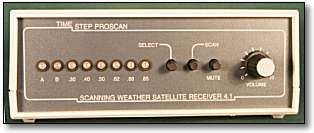
This receiver has become a legend in the weather satellite
field with over 2,500 in service all over the world. In tests
this receiver has outperformed every other similar receiver.
It provides greater signal to noise and hence better image
quality. It is more resistant to pagers and other nearby radio
transmissions. It is easy to use and has direct frequency read
out. It can be computer controlled so that completely automatic
operation is possible.
All
6 known APT satellite frequencies are fitted and just in case
there are two spare unallocated channels. There is selectable
channel lockout if some satellites are not required. The PROscan
receiver uses a lot of filtering, 3 coils in the optional preamplifier,
4 coils in the RF amp (total 7 coils at RF), 3 coils in the
oscillator, 1 matching coil at first IF, 5 ceramic filters
at first IF, 5 coils at second IF (total 11 IF filters) and
a quadrature discriminator for linearity and high ultimate
signal to noise. As with any weather satellite receiver, you
need an interface and software to get images into your computer.
APT 137 Preamplifier
This preamplifier has 3 separate functions. The first to increase
the sensitivity of the receiver so that you can receive low
passes if you want to. The second to recover the loss of the
co-ax cable. And the third is to provide extra RF filtering
which is achieved by an additional 3 tuned circuits. The preamplifier
fits directly underneath the polar antenna.
For more demanding applications, the Enhanced Polar Preamplifier
is designed to go with our Quadrafilar Helix antenna, although
it can equally be used with our crossed dipole or any other
antenna where the best possible performance is required. It
has the lowest noise figure on typically just 0.5dB and bandpass
filtering giving over 50dB rejection to pagers on 153MHz.
NOAA for Windows receiver-interface-software
This is a system mainly intended for the marine
market, although for those wanting a quick and easy system,
this is it ! In an incredibly tiny package we supply a complete
NOAA receiver and a computer interface. So you choose an antenna,
plug it in to the NOAA for Windows unit and plug the other
end into your computer, simple ! The software is the same as
the PROsat for Windows and you even have a GPS input to give
accurate time and position indication.
The receiver has both 137.50 & 137.62MHz to enable all
existing and future NOAAs to be received and can be upgraded
to use a Geostationary receiver. All of the functions are computer
controlled and completely automatic reception can be enabled.
If you have any sort of boat and a notebook computer, this
is the system you will want.
Cable
We supply RF cable in two lengths, 20m (65 feet) and 40m (130
feet). This cable is extremely high quality 75 ohm semi-air
spaced and comes with connectors ready fitted. This cable is
only 6mm (1/4") diameter and outperforms most 1/2" cable
due to its construction and dielectric losses. It is foil and
braid screened to eliminate any influx of interference. Although
other, sometimes cheaper cable appears to have the same specification,
in practice we find that it does not offer the same performance
or deteriorates in the sun and rain.
What do i need for...
An
APT Polar system
Antenna
Crossed
dipole : Good general purpose low cost
Quadrifilar helix : Especially for marine
Preamplifier
Use
with the PROscan receiver to get increased range or to
make up for 40m cable loss. Not needed with NOAA for
Windows and 20m cable
Cable
Choose
either 20m or 40m
Receiver
PROscan
: The best receiver
NOAA for Windows : Small and easy to use
Interface
/ software
PROsat
for Windows i :The definitive versatile
unit with full i software
PROsat for Windows LC : Low cost with full i software
NOAA for Windows: includes full i software
Power
supply
Timestep
90-260V PSU
Upgrades
Meteosat
or GOES system, Dish, preamplifier, 20m cable, Meteosat/GOES
receiver. Full i software will support the upgrade